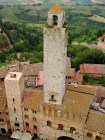
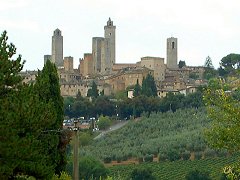
 San Gimignano is a small city with
about 7000 inhabitants in the province of Siena. It is situated
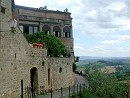
on a hill, surrounded by the lovely Tuscan countryside. It became
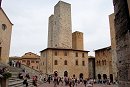
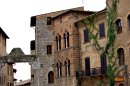
famous mainly through its exceptional medieval architecture, in
particular its numerous medieval towers (12th – 14th century),
which have survived. They rise from the small houses visible in
the distance, and gave the city the nickname “Manhattan of
Tuscany”. 15 of the original 72 towers still dominate the
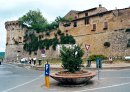
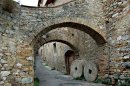
almost unchanged, well preserved, historic centre. The walled city
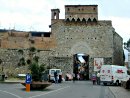
can only be accessed by the medieval city gates. Especially beautiful
is the Porta San Giovanni, the main gate, which dates back to the
13th century. Since 1990 the historic centre has been on the UNESCO
World Heritage list. San Gimignano is a small city with
about 7000 inhabitants in the province of Siena. It is situated
on a hill, surrounded by the lovely Tuscan countryside. It became
famous mainly through its exceptional medieval architecture, in
particular its numerous medieval towers (12th – 14th century),
which have survived. They rise from the small houses visible in
the distance, and gave the city the nickname “Manhattan of
Tuscany”. 15 of the original 72 towers still dominate the
almost unchanged, well preserved, historic centre. The walled city
can only be accessed by the medieval city gates. Especially beautiful
is the Porta San Giovanni, the main gate, which dates back to the
13th century. Since 1990 the historic centre has been on the UNESCO
World Heritage list.
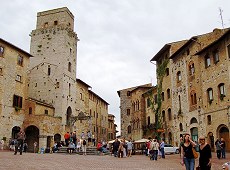
The heart
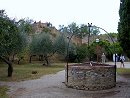
of the city beats on the Piazza della Cisterna – a beautiful
square surrounded by medieval palaces, in the middle of which an
ancient cistern is located. There are many small restaurants, where
one can enjoy the medieval atmosphere with good Italian food and
drink. Of course the local white wine , “Vernaccia di San
Gimignano” and “the world famous homemade ice”
of the Galateria are a must when visiting here.
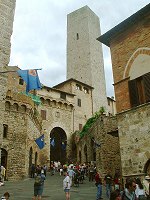 On the Palazzo
del Duomo is the main church of the city, the Collegiate of Santa
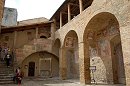
Maria Assunta. The former cathedral was consecrated in 1148 and
is famous for its beautiful frescos. Left of the church is the Palazzo
del Popolo with the “Torre Grossa” (13th century). It
is the only tower in San Gimignano which can be visited and climbed.
The 54 m high platform offers a spectacular view of the city and
its surroundings. The palace now serves as the On the Palazzo
del Duomo is the main church of the city, the Collegiate of Santa
Maria Assunta. The former cathedral was consecrated in 1148 and
is famous for its beautiful frescos. Left of the church is the Palazzo
del Popolo with the “Torre Grossa” (13th century). It
is the only tower in San Gimignano which can be visited and climbed.
The 54 m high platform offers a spectacular view of the city and
its surroundings. The palace now serves as the City Hall and houses the well featured
municipal museum. City Hall and houses the well featured
municipal museum.
In countless small shops, established in the medieval streets,
one can find a large selection of wines, specialities and a variety
of arts and crafts, the most beautiful being the ceramics, which
are a perfect dream!
It is supposed that the origins of San Gemignano go back to the
3rd century BC when it was an Etruscan settlement. The first documented
mention, however, only dates back to the 10th cent. The name of
the city is said to come from the holy Bishop Geminianus of Modena,
who is said to have protected the city from the barbaric hordes
in the 4th cent.
|