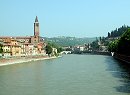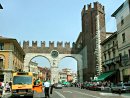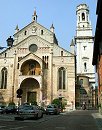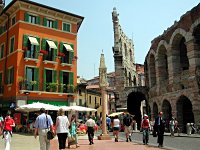
 Verona is situated on both sides of the Adige river and has a picturesque Old Town withnumerous historical buildings, many of which belong to the UNESCO World Heritage and reflect the turbulent history of the city. Originally a Celtic settlement, the city became in 89 v.CH Roman colony. In 489 AD Theodoric the Great, King of the Ostgoths, conquered Verona and made it his residence. 80 years later it fell into the hands of the Langobard’s King Alboin and in the 10th c. belonged to the Duchy Carinthia (Southern Austria). Finally in the 12th c. Verona received its town charter, but fell, however, again and again under foreign rule. In 1797 the Austrians made it their strongest fortress and only in 1866 did Verona became Italian Today Verona is a province capital with approximately 250,000 inhabitants.
 We sauntered through the narrow streets, with their time-honoured Patrician houses, where exclusive fashion shops and restaurants have established themselves, and enjoyed the unmistakable charm of the city.
Sightseeing
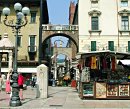
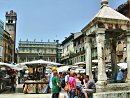
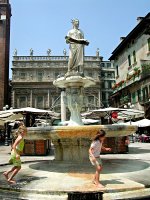 Madonna Verona Especially worth seeing is the historic centre of the medieval city republic with the Piazza delle Erbe – market place, shopping centre and forum. It is one of the most beautiful places in Italy, surrounded by splendid palaces, middle class houses, towers and the city’s landmark in its centre – the fountain with Madonna Verona who is still today watching over the lively hustle and bustle of the market.
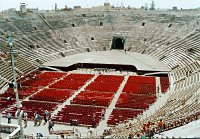
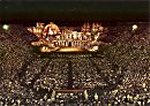
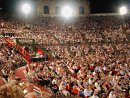
 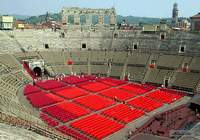 Verona Arena view to the stage. The most famous sight in Verona is the amphitheatre, the Arena, completed around 30 AD. With a total length of 139 meters and a width of 110 meters it is one of the largest amphitheatres in the world and, after the one in Rome, the best preserved in Italy. It can seat some 25,000 spectators in its 44 tiers of marble seats. Originally used in a traditional way, it is today the setting for monumental opera performances produced for the famous opera festivals which take place every year. We were able to realise a cherished dream and attend a performance of Verdi’s ‘Nabucco’. This was a grandiose production and an inconceivably beautiful experience. The ‘chorus of the prisoners’ was so overwhelming that the endless applause of the audience forced an encore. After the performance, 14,000 spectators showed their appreciation of the excellent artists by loud ovations, which ceased when, suddenly, a piano was brought onto the stage and the ‘Nabucco’ singer gave various encores in which the audience joined in – what a choir! It was an incomparable atmosphere and an unforgettable experience.
 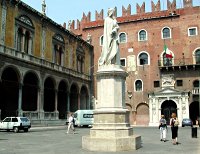 Verona piazza dei signori with Dante statue In the immediate neighbourhood of the Piazza
 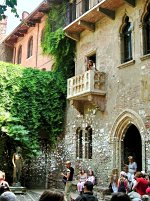 delle Erbe, there is the Piazza dei Signori with a statue of Dante in its centre, Verona Juliet's Balcony It is the most aristocratic place in the city and commonly called "Verona's salon".
 Also close to Piazza delle Erbe the house of Juliet, the ‘Casa di Giulietta’ can be found. The famous balcony in the small inner court, where Romeo and Juliet promised each other eternal love, has a magic attraction for countless visitors every year. It is moving to enter the place where the tragic story began, which Shakespeare made immortal. Beside the entrance to the house is a bronze statue of Juliet and on the walls lovers from all over the world have left their messages on small strips of paper.
This charming city is full of magnificent historic monuments and places and certainly a sail on the Adige River is an exciting experience.