Main Entrance,
Outer Court
South
 |
|
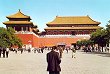
Meridian Gate
|
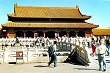 |
Gate of
Supreme Harmony
|
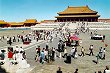
|
| Harmony Square
|
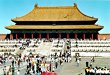 |
Hall of
Supreme Harmony
|
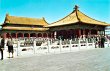 |
|
Halls of Medium / Preserved
Harmony |
|
UNESCO World Heritage
 The Forbidden City was a fascinating experience – for its
marvellous architecture as much as for its dimensions. Situated
in the very heart of the ancient city of Beijing, it covers an area
of 72 hs, with palaces, gates and pavilions, altogether comprising
9999.5 rooms – one less than the mythological number of 10,000
rooms in heaven. The city is surrounded by a six.52 meter
wide, 6 meter deep moat and a ten meter high, 3,400 m long city
wall.
The Forbidden City was a fascinating experience – for its
marvellous architecture as much as for its dimensions. Situated
in the very heart of the ancient city of Beijing, it covers an area
of 72 hs, with palaces, gates and pavilions, altogether comprising
9999.5 rooms – one less than the mythological number of 10,000
rooms in heaven. The city is surrounded by a six.52 meter
wide, 6 meter deep moat and a ten meter high, 3,400 m long city
wall.
The construction of the palace complex began in 1406 and was
completed in 1420. Up to the revolution in 1911 24 emperors
of the Ming and Qing dynasties had reigned and lived here.
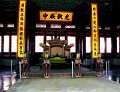
Thus the forbidden City houses numerous rare treasures as well as
a range of well preserved architectural masterpieces of the Ming
and Qing dynasties. It is listed by UNESCO as the largest collection
of preserved ancient wooden structures in the world and is one of
the most popular tourist attractions worldwide, which makes it difficult
to assess the sights, as hundreds of people crowd in, particularly
round the palaces, to catch a view of the interior, which can only
be viewed from the outside.
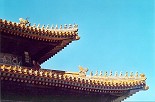
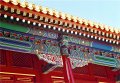
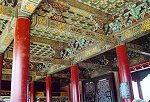
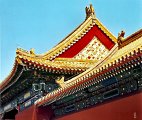
The elaborately restored marvellous halls,
pavilions and gates with splendid painted colourful decoration and
curved roofs are of stunning beauty and convey a fascinating impression
of the imperial splendour and architecture where colours, numbers
and symmetry play an important part. Yellow is a royal colour, as
exemplified by the glazed tiles on the roof. The red colour
of the walls symbolizes happiness and auspiciousness. Usually
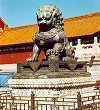
mythological animals decorate the curved ends of the roofs. The
more animals, the more important the building.
The major buildings of the palace are aligned on a north-south
axis that extends beyond the walls towards the Temple of Heaven
complex in the south and towards the bell and drum towers in the
north. The complex is divided into two parts by the Gate of heavenly
Purity (Qian Qing Men).
|
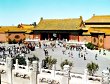
Gate to the
Inner Court
Centre
 |
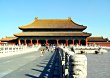
Gate of
Celestial Purity,
|
|
Hall of
Celestial Purity
|
|
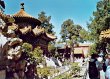
| Imperial Garden
|
|
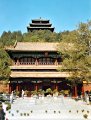
Gate of
Divine Might
North exit
|
|
 UNESCO World Heritage